Sales tax calculation, returns filing, exemption certificates and nexus monitoring, with published per-state pricing on its Core plans.
$79 per state/month, or $799 per state/yearSubscriptionCloud
For growing companies with sales tax nexus in more states: Avalara, Anrok and Zamp, and when a managed filing service beats running the software yourself.
Once you have a shortlist, use our head-to-head comparisons to evaluate finalists side by side. Our finance glossary covers the terms vendors use in demos, and buyer guides go deeper on specific workflows. Free evaluation templates can help structure your scoring process.
We rely on vendor documentation, pricing pages and other primary sources. We do not use G2 or Capterra ratings as ranking inputs.
Material corrections can be submitted through the contact page. We update pages when a claim can be verified against a stronger source.
Read the full review methodology and sponsored disclosure.
This page is about US sales and use tax, not income tax. The usual story: revenue crossed economic nexus thresholds in a handful of new states, a marketplace or second storefront went live, and nobody is sure whether the SaaS product is taxable in Texas or New York. The first registrations are due, and the choice is between a tax engine your team operates and a service that files for you.
Sales tax exposure at this stage grows with the business, not with the tax team. Most companies have no tax specialist yet, so the finance lead or an accountant ends up owning registrations and returns on top of the close.
Ordered for a company adding states quickly across more than one channel, from the broadest engine to the narrower and newer options.
The one to price first when several channels feed sales tax. Core Compliance bundles AvaTax calculation, Managed Returns for filing and remittance, nexus monitoring in all 50 states and exemption certificates, at a published $79 per state per month or $799 per state per year.
Watch for: Registration is extra at $403 per location, and the per-state price scales with every new state. Companies above $50M in revenue go to a custom quote, and no free trial is listed. Read the full Avalara profile.
Built for SaaS and digital services, where the hard question is whether a subscription is taxable at all in each state. It connects to billing systems such as Stripe and Chargebee and, per our profile, tracks exposure before you register.
Watch for: Less suited to physical goods or a mixed catalog. Pricing is quote-based, and international coverage is still expanding. Read the full Anrok profile.
The managed-service option. Zamp handles registration, calculation, filing and remittance for you, which suits a company that would rather not staff sales tax at all while states are being added.
Watch for: You give up some control over tax decisions, and our profile notes managed pricing runs higher than software-only tools. Coverage is US only. Read the full Zamp profile.
A fit for ecommerce-heavy companies selling on Shopify, Amazon, WooCommerce or BigCommerce. TaxJar is now part of Stripe and covers calculation, nexus tracking, reporting and filing across US states.
Watch for: AutoFile carries per-state filing fees on top of the subscription, and it may overlap with Stripe Tax if you already bill through Stripe. Limited support outside the US. Read the full TaxJar profile.
Aimed at companies starting from zero compliance that need to catch up fast. It uses machine learning to classify products and determine taxability, then handles filing and remittance.
Watch for: A newer platform with a shorter track record. Its automated classifications can need manual review on edge cases, and ERP integrations are limited. Read the full Kintsugi profile.
Runner-up: Sovos suits a mid-market company that already has VAT or e-invoicing obligations abroad alongside US sales tax. For a domestic-first company adding US states, its quote-based pricing and module-by-module implementation are more than the problem calls for.
Usually a poor fit: Enterprise engines such as Vertex before you have an ERP team to support them, and practitioner tools such as Drake Software or Intuit ProConnect, which prepare returns for tax firms and do nothing for sales tax. Tracking nexus in a spreadsheet also tends to break once you file in more than a few states.
For a feature-level comparison of engines, see sales tax automation software. If most of your volume runs through online stores and marketplaces, tax software for ecommerce goes deeper on facilitator rules.
Sales tax calculation, returns filing, exemption certificates and nexus monitoring, with published per-state pricing on its Core plans.
Anrok provides sales tax compliance purpose-built for SaaS companies, handling taxability determinations, calculations, and filing for digital products.
Zamp offers fully managed sales tax compliance as a service, handling registration, calculation, filing, and remittance for growing businesses.
TaxJar automates sales tax calculations, reporting, and filing for ecommerce businesses across all US states with nexus.
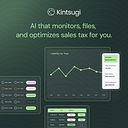
Kintsugi uses AI to automate sales tax compliance for startups and growing companies, covering nexus analysis, calculations, and filing.
Usually when you cross economic nexus in a second or third state, or when more than one channel collects tax. At that point rates, filing calendars and marketplace rules multiply faster than a spreadsheet can track them.
Software such as Avalara or TaxJar keeps the returns in your hands, which suits a team that wants to review every filing. A managed service such as Zamp takes over registration, filing and remittance, which suits a team with no one to own it. Compare the fee at your expected state count, not your current one.
In some states yes, in others no, and a few tax it partially. That is why SaaS companies often look at Anrok, which is built around software taxability. Test your own plans in a demo before relying on any default.
Core Compliance is published at $79 per state per month, or $799 per state per year. Filing in eight states on the annual plan is about $6,400 a year before extras such as registration at $403 per location. Companies over $50M in revenue get a custom quote.